

Summary: An AI implementation plan moves a prioritized business use case into a governed production workflow, while an AI strategy decides where AI could create value and what to invest in. The AI implementation plan template organizes the work across four connected layers—focus areas, objectives, projects, and KPIs—then links the pilot’s baseline, controls, owners, and success measures to a production decision.
Key figures
- AI implementation takes a use case from a business goal to a governed production system.
- A data-readiness assessment checks data existence, accuracy, legal and technical access, bias, and sensitive information.
- A pilot should use production or production-like data and real users, with go/no-go criteria tied to the baseline.
- Production monitoring should cover performance, data drift, cost, and user adoption.
What is an AI implementation plan, and how does it differ from an AI strategy?
An AI implementation plan takes a business use case from a goal to a governed system in production. An AI strategy determines where AI could create value and what to invest in; implementation delivers a prioritized use case.
A pilot tests whether a solution is possible, while production AI tests whether it can operate within a real workflow. Production brings users, permissions, integrations, costs, and accountability into scope. A proof of concept may use curated data and a small user group, but production must handle real users, changing data, permissions, and failures.
Use the AI implementation Plan Template You Can Adapt for Your Business to make that transition visible. The template should distinguish a demonstration from a working process. Keep the planning document focused on the prioritized use case and the controls needed to run it.

Compare AI implementation consultants
What should an AI Implementation Plan Template You Can Adapt for Your Business include?
A useful plan links focus areas to objectives, projects, and key performance indicators (KPIs), then specifies what each initiative is meant to change. Include the business problem, target users, current baseline, success measures, and acceptable risk level.
For business owners and operations leaders, the AI implementation plan template can serve as a practical working document. The plan template should capture the desired improvement, first task, owners, permitted inputs and actions, learning approach, and criteria for expansion. It should also name the sponsor, workflow owner, users, reviewers, technology contact, and exception handler.
| Plan area | What to record |
|---|---|
| Business and users | Problem, target users, baseline, success measures, acceptable risk |
| Delivery and control | Focus area, objective, project, KPI, owner, permitted actions |
| Readiness | Business fit, data, integration, governance, operational readiness |
Use the implementation plan to connect these fields rather than treating them as separate checklists; production readiness includes business fit, data readiness, integration, governance, and operational readiness.

How should a business prioritize AI use cases by expected value, feasibility, and data readiness?
Compare candidate use cases using the same criteria: business value, data readiness, technical complexity, and risk. Add expected value, task frequency, usable inputs, and review effort so the comparison reflects how work actually happens.
The AI implementation plan can hold this comparison without pretending that every opportunity is equally feasible. Use the template to rank by value, feasibility, risk, and reuse potential. No scoring weights or pass thresholds are provided here, so agree on those locally rather than treating invented scores as evidence.
| Candidate use case | Expected value | Frequency | Usable inputs | Review effort | Readiness, complexity, and risk |
|---|---|---|---|---|---|
| Candidate A | Assess | Assess | Assess | Assess | Assess |
| Candidate B | Assess | Assess | Assess | Assess | Assess |
| Candidate C | Assess | Assess | Assess | Assess | Assess |
Check whether required data exists, is accurate enough, and is legally and technically accessible; identify bias or sensitive information that needs controls. Assess quality, consistency, completeness, access, security, freshness, lineage, retention, and sensitivity. Use the planning document to record the evidence behind each candidate’s ranking.

See AI implementation consultant rates
What steps should a business follow to move an AI use case from assessment through pilot to production?
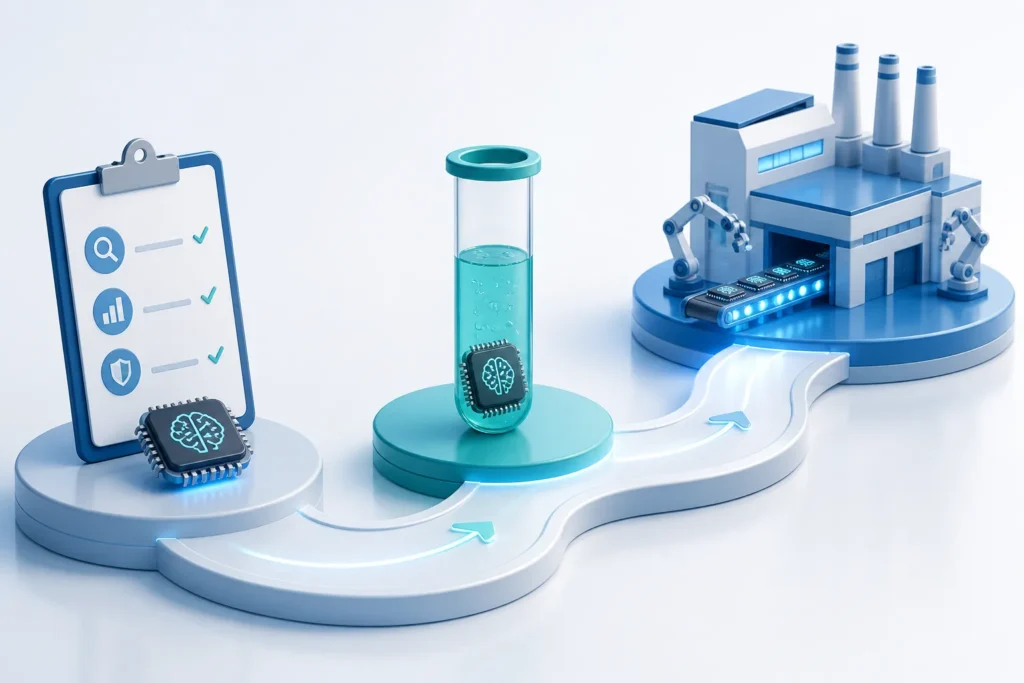
Move from a defined business outcome and baseline through readiness assessment, approach selection, controlled pilot, and an evidence-based production decision. The AI implementation plan template can make each gate, deliverable, owner, and dependency explicit without assigning unsupported calendar durations.
- Confirm the outcome and baseline, then assess data readiness.
- Select an approach: an existing platform or proven tool may be enough; a custom model may suit a competitive-advantage use case or one built around proprietary data.
- Run a time-boxed pilot with production or production-like data, real users, and go/no-go criteria tied to the baseline.
- Before building for production, confirm the use case, owner, baseline, user group, success metrics, and risk tier; build a minimum controlled workflow with monitoring, human review, logging, and user feedback.
Test routine tasks as well as cases with limited information or conflicting sources. Revise the pilot if corrections consume its expected benefit, inputs are unavailable, or employees avoid the workflow. Use the plan template to record the decision and the implementation plan to keep the pilot’s next gate clear.
How can a business estimate the costs, staffing, data, and technology requirements for an AI implementation?
Build the business case around the full cost and capability needed to run the workflow, not only the initial tool or model choice. The AI implementation plan template can list implementation, adoption, monitoring, and support, alongside model or license fees.
Include model usage, token consumption, infrastructure, caching, and traffic patterns in cost estimates. The available claims provide cost categories but no price ranges, staffing rates, or project timelines. Don’t fill those gaps with assumed figures; obtain estimates for the specific use case.
Identify gaps in machine learning, data science, and data engineering. Production work may also involve AI/ML engineering, cloud infrastructure, DevOps, MLOps, and agentic AI development. Name business, technology, and risk owners before production.
Compare off-the-shelf tools with custom-built solutions, and consider whether existing platform capabilities or a proven tool can serve the use case before choosing a custom model. Use the template to document the trade-offs, then use the planning document to assign the people accountable for operating and supporting the chosen approach.

Find AI implementation consultants on Fiverr
What metrics and baseline measurements should be used to determine whether an AI pilot is successful?
Measure the process before building, then compare pilot results with that baseline using agreed technical, operational, and business outcomes. Record measures such as hours saved, cycle time, error rate, revenue per customer, or risk events avoided.
The AI implementation plan template should give each KPI an initial value and a target value. Track relevant outcomes such as accuracy, latency, hours saved, cycle time, revenue influenced, cost reduced, and customer satisfaction. Agree before deployment on output quality, unacceptable errors, latency, cost, and when human escalation is required.
For an existing process, complete several examples and record preparation time, checking time, and corrections. Include the whole process in the pilot evaluation: generation alone misses review, corrections, and ongoing upkeep. Agree on a quality standard and consider total effort, repeat use, exceptions, and maintenance. Use the plan template to keep those measures together, and use the implementation plan to compare the actual workflow with the intended improvement.
What data, security, privacy, and operational risks should an AI implementation plan address?
An AI implementation plan should classify use cases by risk and apply controls proportionate to the potential impact. Those controls can include human review for consequential decisions, bias and accuracy testing, security review, logging, and documentation.
The AI implementation plan template should address privacy, fairness, and algorithmic transparency. For production, cover approval rights, human review, audit logging, privacy, security, prompt and retrieval controls, model evaluation, and escalation.
For tools that can take actions, use least-privilege access, validate consequential actions, and involve people when the possible impact warrants it. Before scaling, test data quality, access permissions, API integrations, failure handling, and dependencies.
Make the pilot checklist operational: approved tools and inputs, action boundaries, representative test cases, a reviewer, exception handling, practice support, and a decision date. Use the template to assign those safeguards and the planning document to make exceptions and escalation responsibilities clear.
After a successful pilot, how should a business scale the AI solution and monitor its performance?
Use production evidence to decide whether to expand, redesign, or retire the pilot. Expand only when outputs meet the agreed standard, total effort is worthwhile, and an owner can maintain the workflow. The AI implementation plan template should record that decision and the evidence behind it.
Set a rollout gate around agreed quality, reliability, latency, and cost targets over an evaluation period; require no unresolved critical issues and document the go/no-go decision. Expand in stages so new problems remain visible.
Monitor performance, data drift, cost, and adoption, and assign an owner plus a fallback for system failure. Once use cases are proven, consider reusing shared data pipelines, approved models, governance templates, and a small center of excellence.
Include employee practice in rollout: provide context, recognize weak results, verify claims, and know when not to use AI. For business owners and operations leaders, the plan template can connect training to the workflow; use the implementation plan to keep expansion and ongoing monitoring tied to accountable owners.
Hire AI implementation consultants
Executive summary
- Define the business outcome and baseline before selecting an AI use case.
- Compare opportunities using value, feasibility, risk, and reuse potential.
- Set pilot acceptance criteria and evaluate the full process, including review and upkeep.
- Scale in stages and assign an owner, monitoring responsibilities, and a failure fallback.
- Copy this AI implementation plan template into your own tools, fill in one use case first, and expand it once the pilot proves its value.
Common client questions
- What is an AI implementation plan?
An AI implementation plan turns a prioritized business use case into a governed production system, while an AI strategy determines where AI could create value and what to invest in.
- How should you prioritize AI use cases?
Compare candidate use cases by business value, data readiness, technical complexity, and risk, then consider expected value, frequency, usable inputs, and review effort.
- What should an AI pilot include?
A pilot should be time-boxed, use production or production-like data and real users, and have go/no-go criteria tied to the baseline.
- How should you monitor AI after a pilot?
Monitor performance, data drift, cost, and adoption, with a clear owner and a fallback if the system fails.
