

Summary: AI change management prepares employees, workflows, leaders, and governance for AI implementation, then supports adoption through workflow redesign, training, communication, human review, and measurement. Change management for AI implementation should be planned as a phased effort: for rollouts involving or more users, one source recommends training and managing a structured champion network.
Key figures
- AI change management covers sponsorship, training, workflow redesign, communication, resistance handling, and measurement.
- AI tools are more likely to fit existing workflows when integrated into the systems where employees already work.
- A pilot should provide specific workflow access, support and training, feedback collection, and documentation of early wins.
- Organizations should establish a baseline before the pilot and measure adoption, time saved, productivity, rework, employee feedback, and work quality.
What does Change Management for AI Implementation: Get Your Team On Board involve?
AI change management prepares employees, workflows, leadership, and governance for adopting AI, and supports people as they use AI in daily work. Getting your team on board means treating implementation as organizational change, not just installing a tool. It also requires attention to data security, because prompts, uploaded files, and connected inboxes can expose data.
Use AI change management to distinguish a software update from a redesign that changes how work gets done. AI also calls for ongoing review, since tools can change and perform poorly when conditions change.
| Approach | What the work involves | Management focus |
|---|---|---|
| Routine software upgrade | Upgrade or deployment, without assuming a redesigned process | Distinguish tool rollout from workflow change |
| AI process redesign | Prepare people, processes, and data before launch | Align the workflow and people using the tool |
| Ongoing AI review | Review use and performance after launch | Respond when the tool or conditions change |
For Change Management for AI implementation: Get Your Team on Board, account for people, workflow, and data together; a tool can affect all three.

Hire AI implementation consultants
How should we choose AI use cases and tools that fit our workflows?
Choose AI use cases by starting with employee challenges, operational bottlenecks, repetitive tasks, and a specific business problem you can measure. Your rollout plan starts with the work people need to do, not a technology shortlist. Confirm that the necessary data and network are available, then assess whether the use case has a genuine business need, technical feasibility, and organizational readiness.
Map handoffs and manual steps before choosing a tool, so you can see where an AI-assisted process might fit or need redesign. Prioritize cases where the likelihood of value accounts for how much employees must change their work.
Change management for AI implementation favors tools integrated into the systems where employees already work. A practical starting point is assistive AI: it drafts or recommends, while a person makes the decision. Getting your team on board should keep the business problem and the employee workflow connected throughout selection.
What steps should leaders follow to prepare employees, run a pilot, and roll out AI?
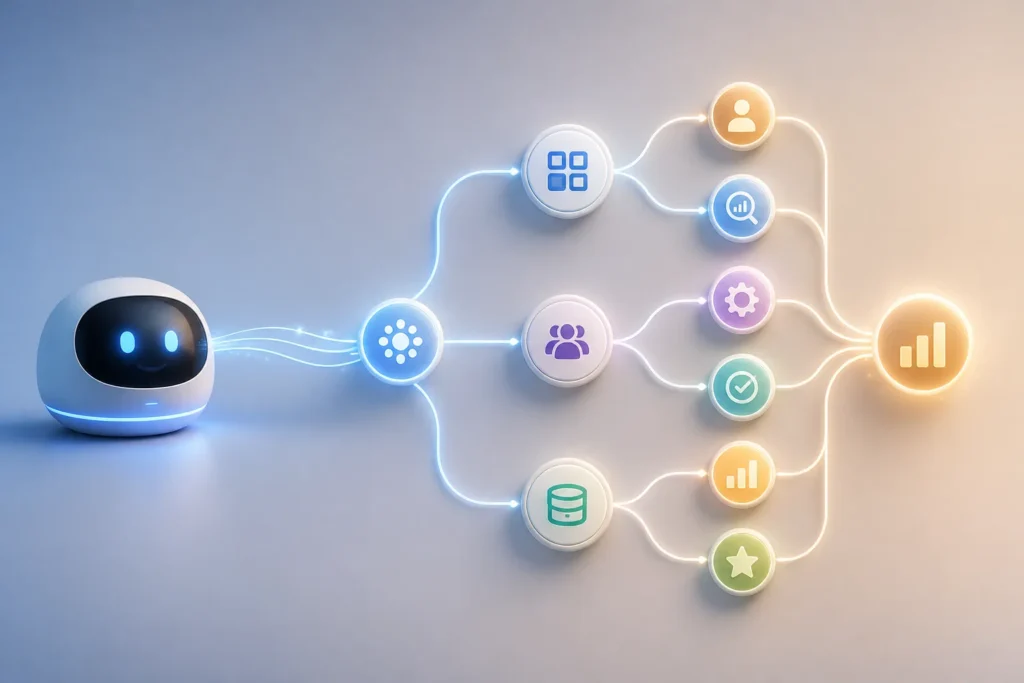
Leaders should set outcomes and governance, name one executive sponsor accountable for the business outcome, and involve change professionals from the start. AI change management turns those commitments into a supported sequence, rather than a one-time deployment.
- Map and document the redesigned workflow, including where AI acts and where a person reviews its work.
- Before recruiting pilot users, explain why AI is being introduced, set expectations, and address concerns.
- Run a small, fixed-period pilot with training, support, feedback collection, and defined success and stop criteria.
- Review results before expanding; prepare pilot users to support peers and continue training.
Your rollout plan treats wider rollout as sequential, supported pilots rather than a simultaneous mass deployment. That gives you a practical checkpoint: use pilot results to decide whether to improve the workflow, continue testing, or expand. Change management for AI implementation keeps employee support in view as use cases grow.

Compare AI implementation consultants
How can managers spot resistance and respond to concerns about jobs, accuracy, and privacy?
Managers can look for early-warning signals such as cynical language, disengagement, skipped meetings, low logins, or increased use of legacy systems. Getting your team on board treats these as prompts to ask questions, not proof of a single cause.
Concerns about job security, the value of expertise, and trusting AI outputs should be addressed openly. Let employees examine pilot outputs and quality data, and explain how human judgment—such as interpretation, problem framing, or relationship expertise—remains important.
AI outputs can contain errors, incomplete information, or bias, so important decisions need human oversight. Preserve employees’ ability to question or override AI decisions. AI change management also includes clear rules for approved tools, prohibited data entry, and who reviews outputs before they reach clients. Prompts, files, and connected inboxes can expose data. The available claims don’t specify consent requirements for employee monitoring or sentiment analysis. Your rollout plan should state that limit plainly.

What training and communication do employees need before and during AI implementation?
Employees need training based on their jobs, with managers trained before their teams. Change management for AI implementation should explain the problem being addressed, what AI will do, what stays human-led, and how employees can raise concerns.
Use role-specific examples rather than one all-hands lecture. Pair a brief conceptual introduction with individual check-ins so employees can apply the tool to their current work. Aim for a useful first-week experience with the tool.
Getting your team on board also means planning for redesigned roles: invest in upskilling and make credible commitments to retrain employees for new roles as AI is adopted. Role redesign and redeployment need training and executive sponsorship to work together. The available claims don’t establish specific multilingual or disability-access requirements. AI change management can still make role-based practice and check-ins part of the plan, rather than relying on a single lecture.

See AI implementation consultant rates
What budget, staff time, and other resources should we plan for AI change management?
The available claims provide no general AI change-management budget range or total staff-time estimate. Your rollout plan should therefore start with a project-specific resource plan, not an assumed industry-wide cost.
Plan for change-management professionals to be embedded in the team and engaged regularly throughout the project. For rollouts involving or more users, one source recommends training and managing a structured champion network. Skills-gap and workload forecasting can inform planning, but the cited claim does not give a cost estimate.
Change management for AI implementation can use program examples as scope references, not as general budgets: Boon Adapt engagements run to weeks for cohorts of to 24, usually managers and team leads. Teamland quotes a fixed fee based on format, cohort size, and customization; no price is supplied. Getting your team on board should separate these scoped examples from your own estimate of staff time and spend.
Which metrics show employee adoption and business value?
Measure employee adoption separately from business outcomes: usage, logins, and task completion show whether people are using AI, while time saved, productivity, quality, rework, and the target business metric show what the implementation delivers. AI change management needs a baseline before the pilot so you can compare later results.
During the pilot, log task time before and after, reviewer-caught errors, employee questions, and incorrect or sensitive outputs. Add employee feedback and qualitative signs such as reduced resistance, positive feedback, and unprompted champions.
One source reports benchmarks of at least 60% active use on Day 7, a 70% first-win rate, and Day repeat use by at least 75% of Day users. Treat those as reported benchmarks, not universal targets. Your rollout plan should tie the measures to the use case rather than treating logins as proof of business value. Change management for AI implementation uses both employee adoption and outcomes to assess progress.
How should we collect feedback after launch and improve the implementation?
Collect employee feedback regularly and show how it affects the rollout. Getting your team on board can use a monthly three-question pulse survey: does the tool help, what is broken, and what do employees want next?
Close the loop by addressing concerns, adjusting support, and making clear that employee input has been heard. Review AI output quality and data access quarterly, and refresh training when features change.
AI change management can also use change-management platforms, which may automate communications, adoption tracking, sentiment analysis, and resistance flags. The available claims don’t specify consent requirements or monitoring safeguards for those capabilities. Your rollout plan should therefore treat employee feedback, review of the tool, and updates to training as continuing work after launch—not as a one-time sign-off.
Find AI implementation consultants on Fiverr
| Group or case | Reported finding |
|---|---|
| employees who receive five or more hours of training | significantly more likely to become regular AI users |
| employees with AI tools available who do not use them | 46% prefer to keep working as they do now |
| Unilever’s global SAP transformation | rollout delays were cut in half |
| a Fortune pharmaceutical company | driving adoption up by 50% within three months |
| Approach | What the work involves | Management focus |
|---|---|---|
| Routine software upgrade | A routine upgrade is distinct from the process redesign AI implementation may require. | Don’t treat AI implementation as only a software upgrade. |
| AI process redesign | Prepare people, processes, and data before launch. | Align the workflow and people using the tool. |
| Ongoing AI review | Review AI use because tools can change and may perform poorly when conditions change. | Keep reviewing performance after launch. |
Executive summary
- Start by defining one focused, measurable business problem and confirming that the needed data and network are available.
- Map the workflow and specify where AI acts and where a person reviews its work.
- Use a small pilot with training, support, feedback collection, and predefined success and stop criteria.
- Track adoption and business outcomes separately, and establish a baseline before the pilot.
Common client questions
- What is AI change management?
AI change management prepares employees, workflows, leadership, and governance for adopting AI. It also covers training, communication, resistance, and measurement.
- How should a team choose an AI use case?
Choose a focused business problem, check that the needed data and network are available, and assess business need, technical feasibility, and organizational readiness.
- Why does AI implementation need human review?
AI outputs can contain errors, incomplete information, or bias, so important decisions need human oversight and employees should be able to question or override AI decisions.
- How can an organization measure AI adoption and business value?
Track adoption and business outcomes separately: measure usage and task completion alongside time saved, productivity, quality, rework, and the targeted business metric.
