
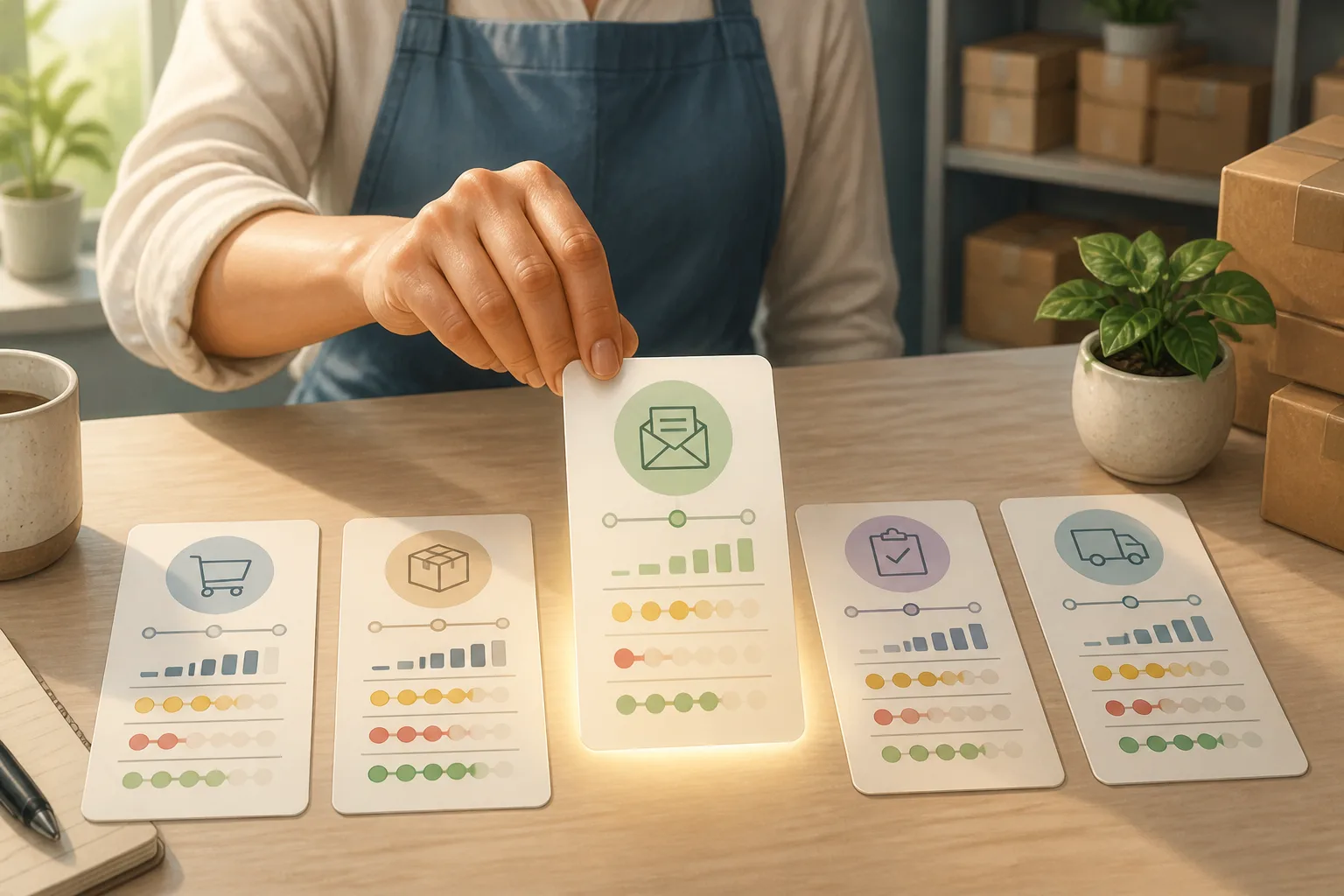
Summary: AI agents can help small businesses with work that needs context, judgment, or decisions across systems, including support, lead follow-up, scheduling, and invoice matching. Adopting AI agents for small business should start with one measurable workflow, limited access, and human approval where needed; one example scorecard targets 95% correct ticket classification.
Key figures
- An AI agent makes decisions, understands context, and completes tasks autonomously with little or no human input.
- Fixed automation is recommended when triggers and steps are predictable and data is structured.
- A cited support scorecard example includes 95% correct ticket classification and replies under words.
- The available claims say implementation costs vary and provide no typical small-business price breakdown.
What is an AI agent, and how does it differ from a chatbot or standard automation software?
An AI agent makes decisions, understands context, and completes tasks autonomously with little or no human input. For your first agent project, the key distinction is whether software only responds, follows fixed steps, or chooses actions based on context and tools.
| Type | How it works |
|---|---|
| Chatbot | Uses language processing, rules, scripts, and limited data to provide predefined answers. |
| Fixed-rule automation | Executes predefined rules and workflows with explicit steps and outcomes. |
| AI agent | Uses context and tools to decide its next action. |
An agent may break a high-level goal into executable steps and try a different approach if one step fails. That plan-and-execute ability is why testing AI agents for small business focuses on workflows with more than a single predefined response. A small business agent pilot should be evaluated by the job the system must complete, not simply by whether it can hold a conversation.

Compare AI business consultants
Which small-business tasks are best suited to AI agents, such as customer support, lead follow-up, scheduling, or invoice processing? | AI Agents for Small Business: Use Cases Worth Trying First
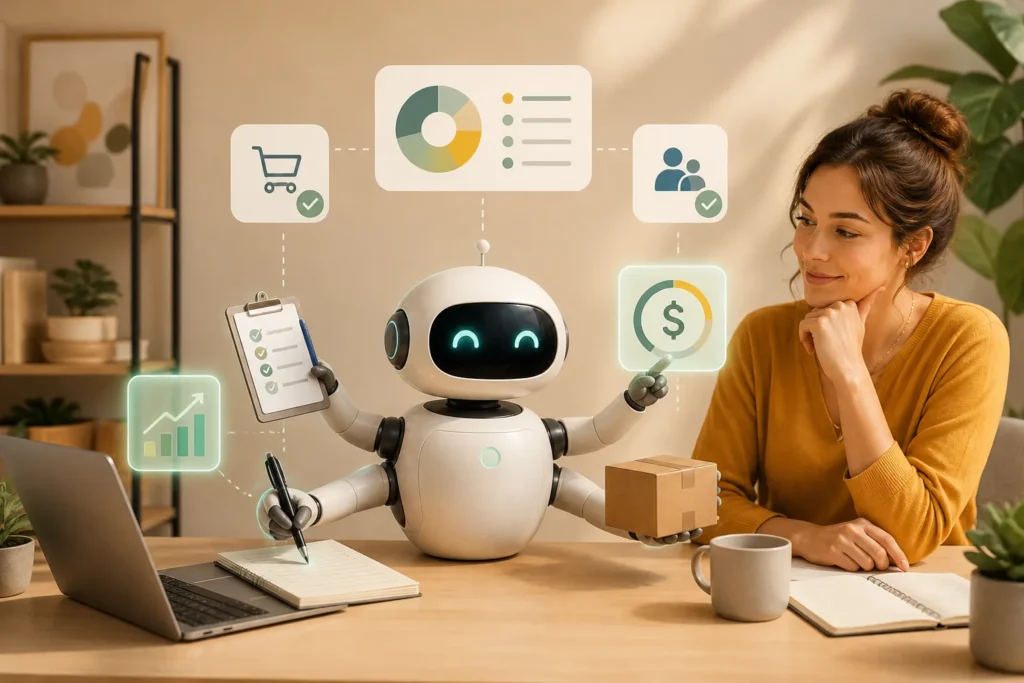
AI agents are worth considering when a task needs judgment or information from more than one system; predictable FAQ answers may be better suited to a chatbot. For choosing an AI agent, practical candidates include support workflows that check an order and refund policy, draft a reply, and prepare a refund action.
Lead workflows can score prospects or draft an initial email for review. With calendar access, an agent can help resolve scheduling conflicts. For finance tasks, an agent can match transactions to invoices and flag discrepancies for human review. Customer-service agents may also process returns, update billing details, or troubleshoot technical issues using back-end data.
Choose the task by its actual steps and access needs, not by a promise of a particular result. This kind of rollout is a useful frame for testing one workflow at a time. Adopting AI agents for small business should prioritize work where decisions or context matter.

How can a small business identify which workflow to automate first based on task volume, time spent, error rates, and business impact?
Start by auditing repetitive, high-volume tasks, then check whether their steps are predictable or require judgment. For your first agent project, the first decision is often whether a fixed workflow is enough or whether the work needs an agent.
- List repetitive tasks and identify where their triggers and data are structured.
- Use fixed automation when the trigger, steps, and data are predictable.
- Consider an agent when the outcome is clear but the path varies, multiple systems must be read, or the work needs judgment or triage.
The available claims provide no scoring formula or benchmark values for time spent, error rates, or business impact. Treat those as measures to collect for your own workflow rather than as established thresholds. Testing AI agents in your business can help frame the choice, but it does not supply a universal ranking. A small business agent pilot should begin with an audit, not an assumed return.
See AI business consultant rates
What software, data access, and integrations does a small business need to deploy an AI agent for a specific task?
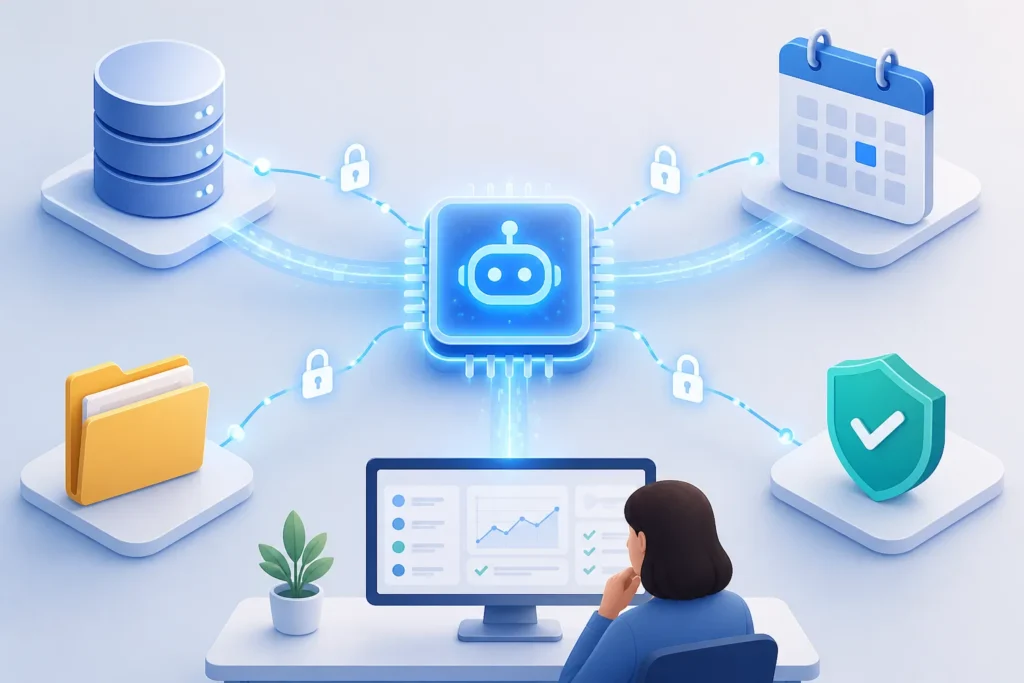
A typical agent setup can include an LLM, APIs, databases or files, approval gates, and logs. For choosing an AI agent, connect only the information and tools needed for the chosen workflow.
For example, CRM access can support lead-score updates, while calendar access can support scheduling-conflict resolution. An agent-building process may involve defining the role, connecting data sources and knowledge bases, configuring reasoning, and setting guardrails and approval requirements. Business knowledge bases, documents, and historical data can also provide material for grounded responses.
The available claims don’t establish a particular dashboard tool or a complete inventory of common data sources. This kind of rollout should therefore start with a task-specific access map rather than a broad list of integrations. Keep permissions aligned to that map, and document what the agent needs to read or update. Adopting AI agents for small business is a workflow-planning exercise as much as a software choice.
How much do AI agents typically cost for a small business, including setup, subscriptions, and usage fees?
The available claims provide no typical small-business price range or breakdown for setup, subscriptions, and usage fees. For your first agent project, that means you’ll need to price the specific implementation rather than rely on a general figure.
The supported cost distinctions are limited: AI agents cost more per transaction than traditional automation, and implementation costs vary. No-code platforms have lowered the entry barrier, while custom enterprise agents require investment in data engineering and API integration. The claims don’t provide a standard subscription charge, usage rate, setup fee, or project timeline.
Ask providers to separate implementation work from recurring and usage-based charges, but treat any quoted amounts as specific to that proposal; the available evidence doesn’t supply benchmarks. Testing AI agents for small business should be evaluated against the workflow and its required integrations. A small business agent pilot can’t supply missing price data, so avoid assuming a typical total cost.
Find AI business consultants on Fiverr
What steps should a small business follow to pilot an AI agent, measure its results, and decide whether to expand its use?
A small business should define a measurable scorecard before deployment, keep human approval for public content at launch, and expand only after monitoring results. Choosing an AI agent works best as a controlled pilot, not an immediate handoff of every task.
- Choose a simple repetitive task and set measures before launch.
- Specify the targets and exceptions the agent must handle; one example is ticket classification accuracy, reply length, and escalation of sensitive tickets.
- Require a person to approve public content rather than allowing direct publication on day one.
- Monitor results and scale patterns that work.
One cited scorecard example targets correctly classifying 95% of support tickets, drafting replies under words, and escalating specified sensitive tickets. Those are example targets, not universal standards. This kind of rollout should be judged against the measures you set. Adopting AI agents for small business is ready to expand only when the monitored workflow performs as intended.
What privacy, security, accuracy, and human-oversight risks should a small business address before using AI agents?
Before deployment, define what an agent may read, write, ask a person about, or never do, and keep people responsible for high-stakes or irreversible decisions. Your first agent project should have explicit boundaries before it receives access to business information.
Set permission scopes and stop-loss triggers that hand work to a human when needed, and use human-in-the-loop review for high-stakes outcomes. Guardrails and approval requirements can be part of the workflow. The sources also identify data-security vulnerabilities and ethical misalignment as risks, including risks tied to processing sensitive data.
Specify which actions require approval and which actions are prohibited; don’t leave those limits implicit. The claims don’t provide a complete accuracy benchmark, so set task-specific checks during a pilot rather than assuming reliability. Your first agent project needs oversight matched to the consequences of an error. A small business agent pilot should stop and route uncertain or sensitive work to a person under the chosen controls.
| Source | Workflow or tool capability stated |
|---|---|
| google.com | AI agents can handle complex, multi-step workflows and integrate with existing… |
| cronkagents.com | The source lists an LLM, APIs, databases, files, approval gates, and logs as… |
| mindstudio.ai | MindStudio says users can connect traditional automations to existing tools… |
| foundationstoneadvisors.com | An agent can be given access to a CRM to update lead scores or a calendar to… |
| Type | How it works |
|---|---|
| Chatbot | Uses language processing, rules, scripts, and limited data to provide predefined answers. |
| Fixed-rule automation | Executes predefined rules and workflows with explicit steps and outcomes. |
| AI agent | Uses context and tools to decide its next action. |
Executive summary
- Start with repetitive, high-volume tasks and assess whether fixed rules can handle them.
- Consider an agent when the path varies or the task needs judgment, triage, or multiple systems.
- Set a measurable scorecard before launch and monitor results before expanding.
- Define access limits, approval points, and stop-loss triggers before deployment.
- Start with one of these AI agents for small business on a single workflow, measure the time saved, and expand only after it proves reliable.
Common client questions
- What is an AI agent?
An AI agent makes decisions using context and can complete tasks autonomously with little or no human input.
- Which small-business tasks can AI agents handle?
AI agents can support lead scoring and outreach drafts, scheduling conflicts, customer-service work, and invoice matching, provided they have the access the workflow needs.
- How should a small business choose a workflow to automate?
Start by auditing repetitive, high-volume tasks, then consider whether the work has predictable steps or needs judgment across systems.
- How much do AI agents cost for a small business?
The available claims give no typical small-business price range or breakdown for setup, subscriptions, and usage fees.
- How should a small business pilot an AI agent?
Define a measurable scorecard before deployment and require human approval for public content at launch.
