
Summary: For many small businesses, Power BI is the cost-led starting point, while Tableau offers a different authoring and visualization approach. Power BI vs Tableau for Small Business depends on your data, users, and sharing needs: cited sources list Power BI Pro at $14 per user monthly and Tableau Cloud Standard Creator at $75, but the figures aren’t a verified future-price comparison.
Key figures
- Power BI includes a desktop authoring product, an online service for viewing and sharing reports, and a mobile application.
- Tableau Cloud Standard is listed at $75 per user per month for Creator, $42 for Explorer, and $15 for Viewer.
- Power BI Premium Per User is reported to offer larger dataset limits and more refreshes.
- A source estimates monthly costs of $700 for five Power BI Pro authors and viewers, compared with $1,050 for Tableau Cloud Standard.
What are Power BI and Tableau, and which products can a small business use?
Business Intelligence (BI) tools collect, process, visualize, and analyze data to support decision-making. Microsoft Power BI and Tableau offer desktop authoring and ways to share reports online, but their products and free options differ. That distinction matters when you evaluate Power BI vs Tableau for Small Business needs.
Power BI includes a desktop report-authoring product, an online service for viewing and sharing reports, and a mobile application. Tableau Desktop users can share visualizations through Tableau Online or Tableau Server. The ledger calls the Power BI online product a service; it doesn’t provide a product-specific name for that service.
Power BI Desktop is free to author with, but the cited source says it runs only on Windows. Tableau Public is free for public work; the source reports no free Tableau authoring tool for private work. For a Power BI vs Tableau for Small Business choice, consider whether work can be public and which desktop setup your team can use. Power BI vs Tableau for Small Business planning should also account for where users will view and share reports.

See AI and data consulting prices and scope
How do prices, features, and license requirements compare in Power BI vs Tableau for Small Business?
Reported license prices vary across the cited sources, so the table compares source-listed figures rather than confirming a current or future price. For Power BI vs Tableau for Small Business budgeting, note both the price differences and the Tableau Cloud Standard minimum of one Creator license.
Power BI Pro is listed at $14 per user per month in two sources, while another lists $10 per user per month. One source lists Tableau Creator at $70 per user per month; another lists Tableau Cloud Standard Creator at $75, Explorer at $42, and Viewer at $15 per user per month. A separate source gives a broader approximate Creator range of $75–$115.
Tableau Cloud Standard organizations need at least one Creator license. For five authors and viewers, one source estimates monthly costs of $700 for Power BI Pro and $1,050 for Tableau Cloud Standard. Power BI Pro is described as including dashboards, report sharing, and collaboration. The ledger doesn’t verify future pricing or licensing changes. Power BI vs Tableau for Small Business costs should therefore be checked against current vendor terms before a purchase.

Which data sources can Power BI and Tableau connect to, and what limits are documented?
Power BI and Tableau both connect to business data sources, but the cited examples emphasize different ecosystems. For a Power BI vs Tableau for Small Business comparison, check whether your actual apps and data stores are covered, rather than assuming every connection has the same setup or capacity.
Power BI connection examples include Microsoft products, Google Analytics, Salesforce, and email marketing tools. Other listed integrations include Azure, SQL Server, SharePoint, and Dynamics 365. A separate source names Microsoft Entra ID, Teams, and Microsoft Fabric. Tableau examples include AWS, Google Cloud, Snowflake, and third-party applications accessed through APIs. Both tools are reported to connect to Google Workspace and cloud warehouses such as BigQuery, Snowflake, and Databricks.
Power BI Premium Per User is reported to offer larger dataset limits and more refreshes. Extensive processing may require Premium or dedicated capacity. The ledger gives no specific refresh frequency, dataset-size thresholds, or Tableau capacity limits. Power BI vs Tableau for Small Business testing should verify refresh behavior and capacity against your own data.

Find AI and data consulting on Fiverr
How do Power BI and Tableau compare for data modeling, dashboards, and visualization?
Power BI combines data-preparation and business-logic tools, while Tableau is described as relying more on clean, well-modeled upstream data. That difference can shape a small team’s data modeling effort: Power BI vs Tableau for Small Business teams may feel different depending on how ready their data is before report building begins.
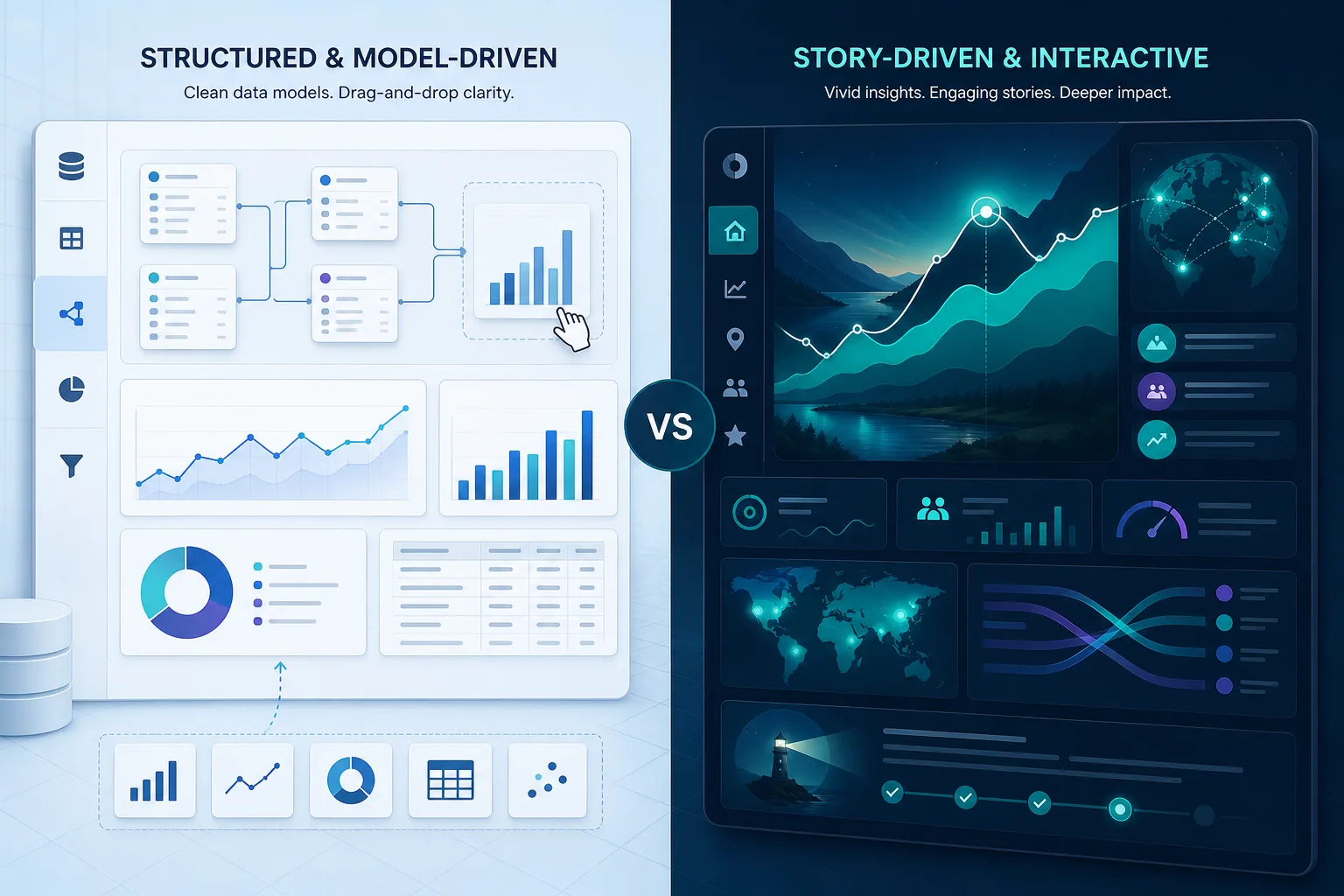
Power BI uses Power Query for data preparation and DAX for business logic. It also offers drag-and-drop reporting and templates. Tableau supports live queries and extracts, and its drag-and-drop view lets users place data types on X and Y axes to build visualizations. One source characterizes Tableau as strong in interactive visualizations and data storytelling.
Whichever tool you use, start each dashboard with a clear goal, prioritize essential metrics, and avoid clutter. Filters and drill-downs can help users focus on relevant information. A source also cautions against using too many widgets. For a Power BI vs Tableau for Small Business pilot, compare whether users can understand and act on the same reporting needs in both tools.

What skills and setup steps does a small business need for each tool?
Power BI setup includes connecting a data source and completing the required authorization, while the cited setup description also involves an Azure tenant integrated through the Office Admin Center. For Power BI vs Tableau for Small Business, plan for both the connection steps and the skills needed to build and maintain reports.
Power BI users can select Get Data to integrate data, then complete an authorization procedure to link it. The source describes an Azure tenant integrated with Power BI through the Office Admin Center as a common setup. Power BI may feel familiar if you already use Microsoft Excel, but the source says DAX can become difficult.
Tableau’s drag-and-drop interface is described as supporting open-ended exploration, although a source says it can take longer to learn than Power BI. Advanced Tableau work may involve Python or R and SQL. The ledger contains no measured beginner learning timeline and no evidence comparing small-business job-listing demand for either tool. Power BI vs Tableau for Small Business skill planning should therefore be based on your team’s existing experience, not an assumed learning period.

Book AI and data consulting help
What trade-offs and risks should a small business consider before choosing?
A cited source identifies Power BI as a usual fit for small businesses with fewer than staff and one to three report builders, pointing to lower cost, free Desktop authoring, and Microsoft familiarity. But Power BI vs Tableau for Small Business decisions should include sharing, administration, and integration—not just the author license.
For larger sharing needs, the cited comparison estimates $700 monthly for five Power BI Pro authors and viewers, versus $1,050 for Tableau Cloud Standard. Microsoft Fabric capacity is reported to start at about $262 monthly for F2, and the source says F64 and above lets free users view content. These are source-reported figures, not a complete cost-of-ownership estimate.
Review data connections and their downstream dependencies, and update connection details regularly; a source recommends audits at least twice a year and ideally every few months. It says credential updates can make unauthorized reuse more difficult. Assign dashboard access by user role. Older systems may lack modern APIs, creating integration challenges. The ledger doesn’t establish comparative regulatory-compliance capabilities or vendor-roadmap details. Power BI vs Tableau for Small Business risk reviews should identify these unknowns before rollout.
How can a small business run a short pilot with its own data?
A useful Power BI vs Tableau for Small Business pilot begins with agreed KPI definitions and prepared data, then compares both tools against the same reporting needs. The ledger recommends modeling data in SQL with a clean star schema and tuning queries before selecting a BI tool. It doesn’t specify a pilot duration, implementation budget, or measured project timeline.
Use a business goal to choose the metrics, and favor measures that are essential, easy to track, and easy to explain. Keep the data and report requirements consistent between the two trials so the comparison reflects the tools rather than different inputs.
- Agree on KPI definitions and the decision each dashboard should support.
- Prepare and model the shared dataset, then tune its queries before building reports.
- Build comparable reports and dashboards in each tool, using the same metrics and user needs.
- Review whether the outputs are understandable and easy to track, and note the setup and sharing requirements for each.
The last two steps are practical comparison guidance, not a measured timeline or promised outcome. For Power BI vs Tableau for Small Business adoption planning, use the pilot findings to identify data-readiness gaps and the work needed to maintain each option.
Browse vetted AI and data consulting gigs
| Product/license | Source | Listed price |
|---|---|---|
| Power BI Pro | confiz.com | $14 per user per month billed yearly |
| Power BI Pro | pnielanalytics.com | $14 per user per month |
| Power BI Pro | vinsys.com | $10 per user per month |
| Tableau Creator | confiz.com | approximately $75–$115 per user per month |
| Tableau Cloud Standard Creator | pnielanalytics.com | $75 per user per month |
| Tableau Creator | vinsys.com | $70 per user per month |
| Tableau Cloud Standard Explorer | pnielanalytics.com | $42 per user per month |
| Tableau Viewer | confiz.com | from $15 per user per month billed yearly |
| Tableau Cloud Standard Viewer | pnielanalytics.com | $15 per user per month |
| Product or license | Source-reported price | Qualification |
|---|---|---|
| Power BI Pro | $14 per user per month, billed yearly; also listed at $14 and $10 | Sources report different figures. |
| Tableau Creator | Approximately $75–$115 per user per month; also listed at $70 | Source-reported figures vary. |
| Tableau Cloud Standard Creator | $75 per user per month | At least one Creator license is required. |
| Tableau Cloud Standard Explorer | $42 per user per month | Listed license price. |
| Tableau Cloud Standard Viewer | $15 per user per month | Listed license price. |
Executive summary
- Check the cited price estimates against current license terms before deciding, since the ledger doesn’t verify future pricing or licensing changes.
- Test your actual data sources, refresh needs, and capacity requirements in a pilot rather than assuming documented connections settle those questions.
- Compare both tools using the same prepared data, KPI definitions, and reporting needs.
- Plan dashboard permissions by user role and review connections, credentials, and downstream dependencies.
Common client questions
- Which is more in demand, Power BI or Tableau?
The ledger doesn’t establish which tool appears more often in small-business job listings. It therefore can’t support a demand comparison between Power BI and Tableau.
- Can I learn Tableau in days?
The ledger doesn’t say whether a beginner can learn Tableau in two days. It reports that Tableau may take longer to learn than Power BI, but gives no measured learning timeline.
- What are the top business intelligence tools?
The ledger doesn’t identify the top three business intelligence tools, so it can’t support a ranked list.
- Is Power BI still relevant in 2026?
The ledger doesn’t establish whether Power BI remains relevant in a particular year. It does report that Power BI offers report sharing, collaboration, and connections to Microsoft products.
